If you are searching for the definitive guide to strategy and tactics in chess, you have come to the right place. If you’ve spent any time studying chess, you’ve probably heard the terms strategy and tactics thrown around constantly. But what do they actually mean? And more importantly, how do you know when to focus on one versus the other?
Understanding the difference between chess strategy vs. tactics is one of the most important breakthroughs a developing player can make. It changes how you evaluate positions, plan your moves, and ultimately win games. In this chess strategy guide, we’ll break down both concepts, explore when each one dominates, and show you how to weave them together into a complete game.
What Is Chess Strategy?
Chess strategy refers to your long-term plans and positional goals. It’s the big picture — the framework that guides your decisions over many moves. Strategic thinking involves questions like:
- Where should my pieces be placed for maximum influence?
- Which pawn structure gives me the best endgame chances?
- Should I play on the kingside or the queenside?
- Is it better to trade pieces or keep the tension?
Strategic concepts include pawn structure, piece activity, king safety, control of open files, and the good bishop vs. bad bishop distinction. None of these yield an immediate checkmate. Instead, they accumulate small advantages that, over time, create a winning position.
Think of strategy as building a house. You need a blueprint before you start hammering nails. A player with a strong strategic foundation always knows why they’re making a move — not just what move to make. If you’re working on your opening repertoire, you’ll notice that every good opening is grounded in strategic principles: controlling the center, developing pieces, and securing the king.
What Are Chess Tactics?
Chess tactics are short-term sequences of moves that exploit specific opportunities in the position. They are concrete, calculable, and often forcing. Tactical motifs include:
- Forks — attacking two pieces at once with a single piece
- Pins — immobilizing a piece that shields a more valuable one
- Skewers — attacking a valuable piece that, when moved, exposes another
- Discovered attacks — moving one piece to unleash an attack from another
- Sacrifices — giving up material for a decisive advantage
- Back-rank mates — exploiting a king trapped behind its own pawns
Tactics are the fireworks of chess. They’re the combinations that make spectators gasp and opponents resign. If strategy is the blueprint, tactics are the hammer and nails that execute the plan. Dedicated tactical training is one of the fastest ways to climb the rating ladder, especially for beginners and intermediate players.
Chess Strategy vs. Tactics: 5 Key Differences
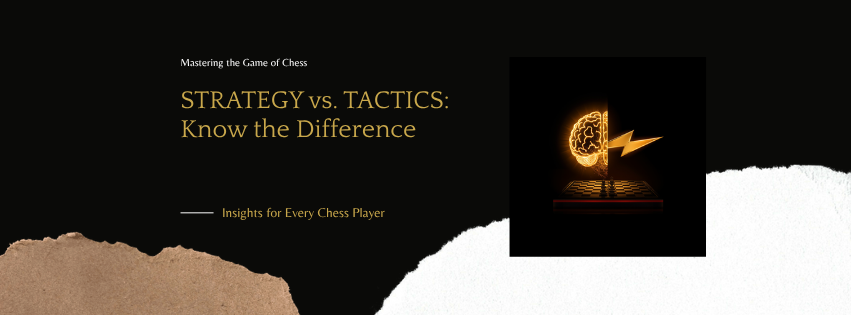
The simplest way to frame the distinction: strategy tells you what to do; tactics tell you how to do it. Here’s a direct comparison:
- Timeframe: Strategy is long-term (spanning many moves); tactics are short-term (typically 2-6 moves).
- Nature: Strategy is abstract and evaluative; tactics are concrete and calculable.
- Goal: Strategy builds advantages gradually; tactics exploit advantages immediately.
- Skill type: Strategy requires positional judgment; tactics require pattern recognition and calculation.
- Visibility: Strategic advantages are often subtle; tactical shots are dramatic and visible.
Former World Champion Mikhail Botvinnik famously said that chess is the combination of both. You can’t win consistently with one and not the other. Even the most brilliant tactician will lose to a solid strategist who never gives them an opportunity to attack — and vice versa.
When Strategy Wins the Game
There are certain types of positions where strategic mastery is the deciding factor. Closed positions with locked pawn chains, for instance, offer very few tactical opportunities. The player who understands piece maneuvering, pawn breaks, and long-term planning will dominate.
Strategy also wins in endgames. When the board is simplified and there are fewer pieces to calculate, raw tactical ability matters less than understanding key endgame concepts: king activity, passed pawns, the opposition, and zugzwang. A player who understands these strategic endgame principles will convert drawn-looking positions into victories.
Consider a common scenario: you have a slight space advantage and better pawn structure. There’s no immediate combination available. A tactically skilled player might grow impatient and lash out, creating weaknesses. A strategically sound player will improve their worst piece, restrict the opponent’s counterplay, and slowly squeeze until the position collapses.
When Tactics Decide Everything
In open positions with active pieces, loose pawns, and exposed kings, tactics reign supreme. One missed combination can end the game instantly, regardless of who had the “better position” on paper.
Tactics are especially decisive at the beginner and intermediate level. The vast majority of games below 1800 Elo are decided by tactical blunders — hanging pieces, missed forks, and overlooked checkmates. This is why coaches universally recommend that improving players dedicate significant study time to solving tactical puzzles.
Even in strategically complex games between grandmasters, the final blow is almost always tactical. Strategy creates the conditions; tactics deliver the knockout punch. Bobby Fischer’s famous “Game of the Century” against Donald Byrne is a perfect example — Fischer’s stunning queen sacrifice was made possible by precise strategic preparation in the preceding moves.
Ready to Master Chess Strategy?
Chess Strategy vs. Tactics: How to Balance Both
One of the most common mistakes developing players make is focusing exclusively on one area. Here’s a practical framework for balancing your training:
For Beginners (Under 1200 Elo)
Spend roughly 70% of your study time on tactics and 30% on basic strategic principles. At this stage, games are won and lost on simple tactical oversights. Learn the fundamental motifs — forks, pins, skewers, and basic checkmate patterns. For strategy, focus on the essentials: control the center, develop your pieces, and castle early. A solid understanding of opening principles will reinforce both areas simultaneously.
For Intermediate Players (1200-1800 Elo)
Shift to a 50/50 balance. Your tactical skills should now be strong enough to avoid obvious blunders, so strategic understanding becomes the differentiator. Study pawn structures, learn how to form and execute plans, and understand the transition from middlegame to endgame. Continue daily tactical training to keep your calculation sharp.
For Advanced Players (1800+ Elo)
Strategic depth becomes increasingly important. Study master games, analyze pawn structures in your specific openings, and work on prophylactic thinking — anticipating your opponent’s plans before they execute them. Tactics at this level are about spotting deep combinations and calculating complex lines accurately.
No matter your level, the key principle is the same: strategy without tactics is the slowest route to victory; tactics without strategy is the noise before defeat.
Building Your Strategic Thinking
If you feel like your tactical skills are ahead of your strategic understanding — a very common imbalance — here are concrete steps to level up:
- Study annotated master games. Pay attention to the reasoning behind quiet moves, not just the flashy combinations. Ask yourself: what was the plan?
- Analyze your own games without an engine first. Try to identify where your plan went wrong before letting the computer show you the tactics you missed.
- Learn pawn structures. Every opening leads to a typical pawn structure with its own strategic plans. Understanding these patterns gives you a roadmap for the middlegame.
- Practice slow chess. Play longer time controls where you’re forced to think deeply rather than rely on instinct and pattern recognition alone.
- Read chess books that emphasize strategic thinking. Classics by authors like Nimzowitsch, Silman, and Dvoretsky offer timeless strategic wisdom.
A structured approach to chess improvement always includes both strategic study and tactical drilling. The players who improve fastest are those who understand how the two work together — strategy creates favorable conditions, and tactics capitalize on them.
For a practical training resource that integrates both strategy and tactics into a single structured program, browse our chess blog for more tips, or explore dedicated training materials designed to build both skills in tandem.
Ready to accelerate your chess improvement? The KingTrap ebook gives you 100+ exercises and proven strategies. Get your copy today.
♛ Before You Go
Grab the FREE 7 Tactics Playbook
The tactics that decide 9 out of 10 games at your level. Free instant PDF download — no spam, unsubscribe anytime.
Resources to Master Chess Strategy Vs. Tactics
To go deeper into chess strategy vs. tactics, here are trusted external resources we recommend pairing with this guide:
Combined with the strategies above on strategic and tactical play, these tools will accelerate your chess progress significantly.