If you are searching for the definitive guide to chess tactics training, you have come to the right place. Tactics win chess games. You can have the best opening preparation and the deepest strategic understanding, but if you miss a fork or overlook a pin, none of it matters. Chess tactics training is the single most effective way to improve your results, especially at the beginner and intermediate level where games are won and lost on combinations.
In this guide, we will break down the most important tactical patterns in chess: forks, pins, skewers, discovered attacks, and double checks. For each one, you will learn what it is, how to recognize it, and how to use it in your own games. We will also cover how to build an effective tactics training routine that delivers real improvement.
Tactical skill does not exist in a vacuum. It works hand-in-hand with solid opening knowledge and a structured training plan. But if you had to pick one area to focus on, tactics would be it.
What Is Chess Tactics Training and Why Does It Matter?
A chess tactic is a short sequence of moves that exploits a specific weakness in your opponent’s position to gain a concrete advantage. That advantage might be winning material (capturing a piece or pawn), delivering checkmate, or forcing a draw from a losing position.
Tactics are different from strategy. Strategy is your long-term plan: where to place your pieces, which side of the board to play on, how to improve your pawn structure. Tactics are the sharp, concrete sequences that execute your strategy or punish your opponent’s mistakes.
Here is the critical insight: tactics arise from positional advantages. When your pieces are actively placed, when your opponent’s king is exposed, when there are undefended pieces on the board, tactical opportunities appear. The better your position, the more tactics you will find. The patterns we cover below are the vocabulary of tactical chess. Once you learn to recognize them, you will start seeing them everywhere.
The Fork
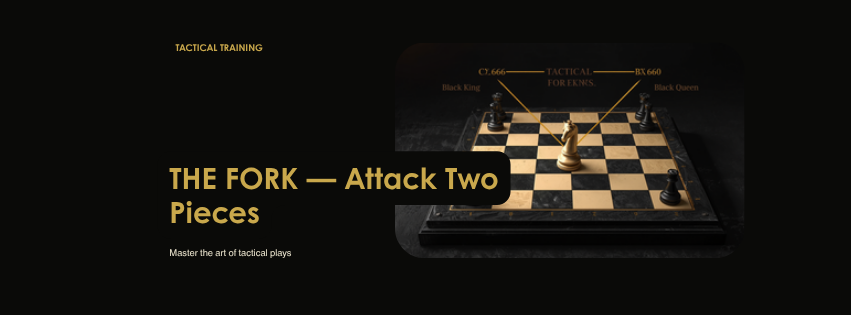
A fork is one of the most common and powerful tactical motifs in chess. It occurs when a single piece attacks two or more enemy pieces simultaneously. The opponent can only move one piece, so you capture the other.
Knight Forks
The knight is the king of the fork. Because it moves in an L-shape and cannot be blocked, a knight fork is especially dangerous. The most devastating knight forks target the king and queen simultaneously, sometimes called a royal fork. The opponent must move the king, and you capture the queen for free.
How to spot knight forks:
- Look for squares where your knight could attack two valuable pieces at once.
- Check if you can force enemy pieces onto vulnerable squares through checks, captures, or threats.
- Pay special attention when the opponent’s king and queen are on the same color squares, since a knight on the opposite color can often find a forking square.
Pawn Forks
Pawns can also deliver devastating forks. A pawn advancing to attack two pieces diagonally is easy to overlook because players tend to focus on the more powerful pieces. A pawn fork that wins a knight or bishop is a common way to gain a decisive material advantage in the early middle game.
Other Forks
Every piece can deliver a fork. Queens are natural forking pieces because they control so many squares. Bishops can fork pieces along diagonals, and rooks can fork pieces on the same rank or file. The key principle is always the same: one piece attacks two targets, and the opponent cannot defend both.
The Pin
A pin is a tactic where an attacking piece immobilizes an enemy piece because moving it would expose a more valuable piece behind it. Pins are one of the most frequent tactical patterns in chess, and mastering them is essential for serious improvement.
There are two types of pins:
- Absolute pin: The piece behind the pinned piece is the king. The pinned piece literally cannot move because it would leave the king in check, which is illegal. Absolute pins are incredibly powerful because the pinned piece is completely paralyzed.
- Relative pin: The piece behind the pinned piece is valuable (like a queen or rook) but is not the king. The pinned piece can legally move, but doing so would lose the more valuable piece behind it. Relative pins are still very strong, but they require more care since the opponent might find a way to break the pin with a counter-threat.
How to exploit pins:
- Pile up on the pinned piece. Add more attackers to the pinned piece than the opponent has defenders. Since the pinned piece cannot move, it becomes a stationary target.
- Attack the pinned piece with a pawn. This is particularly effective because you are attacking a more valuable piece with the least valuable one.
- Use the pin to win the pinned piece or the piece behind it. Sometimes the best approach is to maintain the pin and gradually increase the pressure until something breaks.
Bishops and rooks are the primary pinning pieces. Bishops pin along diagonals, and rooks pin along ranks and files. The queen can also pin, though using your queen for this purpose is sometimes risky because it can become a target itself.
The Skewer
A skewer is essentially a reverse pin. Instead of the less valuable piece being in front, the more valuable piece is in front. When the more valuable piece moves out of the attack, the less valuable piece behind it is captured.
The most common skewer scenario involves a bishop or rook checking the king along a line where another piece stands behind the king. The king must move out of check, and the piece behind it is lost.
Key skewer patterns to know:
- Rook skewer on a rank or file: A rook checks the king, and after the king moves, the rook captures a queen or rook on the same line.
- Bishop skewer on a diagonal: A bishop attacks the king (or queen) along a diagonal, winning the piece behind it when the front piece moves.
- Queen skewer: The queen can skewer along ranks, files, and diagonals, making it the most versatile skewering piece.
Skewers often appear in the endgame when the board is more open and pieces have long, unobstructed lines. Knowing these patterns can turn drawn endgames into wins.
Discovered Attacks
A discovered attack occurs when one piece moves out of the way, revealing an attack from a piece behind it. The moving piece and the revealed piece can both create threats simultaneously, making discovered attacks extremely difficult to defend against.
The most powerful version is the discovered check, where the revealed attack is a check on the king. Since the opponent must deal with the check immediately, the piece that moved is free to capture anything, no matter how valuable, on its destination square.
Why discovered attacks are so dangerous:
- They create two threats at once. The opponent can usually handle one threat but rarely both.
- The moving piece can go anywhere it legally can, regardless of whether it is attacked on its new square, because the opponent must deal with the revealed threat first.
- They are hard to see coming. Players often focus on the piece that moves and miss the attack that opens up behind it.
To set up discovered attacks, look for situations where your pieces are lined up with an enemy piece, with only one of your own pieces in between. Moving that middle piece, especially with a threat of its own, is the recipe for a discovered attack.
Ready to Master Chess Strategy?
Double Check
Double check is the most forcing move in chess. It occurs when both the moving piece and the revealed piece give check simultaneously. Since two pieces are checking the king at the same time, the only legal response is to move the king. You cannot block two checks at once, and you cannot capture two pieces at once.
This means that during a double check:
- Interposing a piece does not work since there are two checking lines.
- Capturing one checking piece does not work since the other still gives check.
- The king must physically move to a safe square.
Double checks often lead directly to checkmate because the opponent’s options are so severely limited. Some of the most famous combinations in chess history feature a double check as the decisive blow. Even if it does not deliver immediate checkmate, a double check almost always wins decisive material because the moving piece can land on any square it wants with total impunity.
How to Build a Chess Tactics Training Routine
Knowing what forks, pins, and skewers are is the first step. Turning that knowledge into automatic pattern recognition during your games requires deliberate practice. Here is how to build an effective chess tactics training routine.
Solve Puzzles Every Day
Daily puzzle solving is the cornerstone of tactical improvement. Aim for 15 to 30 minutes per day, focusing on quality over speed. When you attempt a puzzle, commit to a solution before checking the answer. If you get it wrong, study why the correct solution works and what you missed.
Use Themed Exercises
When you first learn a pattern like the pin, spend a focused session solving only pin-related puzzles. This repetition burns the pattern into your memory. Once each pattern is familiar, switch to mixed exercises where you have to identify which tactic applies, just as you would in a real game.
Work Through Structured Collections
Random puzzles are good, but curated exercise collections that progress in difficulty are better. They ensure you build skills in the right order and are exposed to all the important patterns, not just the ones that appear most frequently in random generators. The KingTrap ebook provides exactly this kind of structured tactical training.
Apply Tactics in Real Games
Play longer time control games where you have time to actually look for tactical opportunities. After each game, review the critical positions and check whether you missed any tactical shots, for yourself or your opponent. This bridges the gap between puzzle solving and real-game performance.
Track Your Progress
Keep a record of your puzzle accuracy and the types of patterns you miss most often. If you consistently miss skewers but rarely miss forks, you know exactly where to focus your next training session. Targeted practice on your weakest patterns delivers the fastest improvement.
Tactical mastery does not happen overnight, but it does happen faster than most players expect. Consistent daily training builds a library of patterns in your memory that fires automatically during your games. Within weeks, you will start seeing combinations that previously would have been invisible to you. Within months, your rating will reflect it.
For a comprehensive training plan that covers tactics, openings, endgames, and more, read our complete guide to chess improvement. And for the exercises themselves, there is no better starting point than a focused, structured training resource.
Your Next Step
Ready to accelerate your chess improvement? The KingTrap ebook gives you 100+ exercises and proven strategies. Get your copy today.
♛ Before You Go
Grab the FREE 7 Tactics Playbook
The tactics that decide 9 out of 10 games at your level. Free instant PDF download — no spam, unsubscribe anytime.
Resources to Master Chess Tactics Training
To go deeper into chess tactics training, here are trusted external resources we recommend pairing with this guide:
Combined with the strategies above on chess tactics training, these tools will accelerate your chess progress significantly.
